Trust the... Terms and Conditions?
I've spent over a decade in the ticketing industry and work with season ticket holders across the country. Part of that work is helping them understand their team's terms so they stay in good standing and can still put their tickets to use when they can't make a game.
The Sixers did something this year I think every season ticket holder should know about. They published two separate versions of their 2026-27 Membership Terms and Conditions: one for purchases on or before July 31, 2026, and one for purchases on or after August 1, 2026. LeBron signed on July 24, and a lot of new buyers came in after that, so the easiest way to think about it is a before-LeBron contract and an after-LeBron contract.
The earlier terms do give longtime and early buyers some real advantages. But both versions have strict rules and serious consequences, so here's the breakdown.
Disclaimer: This article is for informational purposes only and is not legal or formal contract advice. Ticket terms and conditions vary and are subject to change. Always refer directly to your official team documentation and account representative for binding agreement terms.
Check the full terms for the Sixers here
Q: What's the same in both versions?
The foundation. In both, each ticket is a revocable license, not property. The team can revoke a membership with or without cause, and you have no right to renew. Renewal is entirely at the team's discretion.
Q: Which version applies to me?
Ask yourself: did I buy my ticket package before LeBron made his decision, or after? If you purchased on or before July 31, you're on the earlier terms. On or after August 1, you're on the newer terms. If you signed and paid on different dates around the cutoff, check your account documents.
Q: How does renewal work, and what if the team doesn't renew me?
Both versions use auto-renew. If the team offers you a renewal for 2027-28, you'll get a renewal notice with your price and terms. You then have two weeks (unless the notice says otherwise) to tell the team you don't want to renew, in the way the notice specifies. If you don't respond, you're treated as renewed, and your card is charged a non-refundable amount starting two days after the deadline.
The key word is if. Neither version gives you a right to be offered renewal. The team can simply decline to send you a renewal offer, and it doesn't need to give a reason.
Q: What are the resale limits?
Without the team's written consent, you can't sell tickets for money to more than this many games:
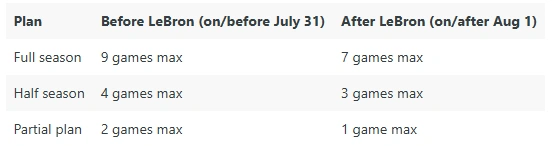
With the team's written consent, you can go above these numbers. Written is the key word. If a rep has told you verbally that a different number is fine, that doesn't change your contract. If you plan to resell more than your limit, it's on you to request that approval and get it in writing.
Transferring tickets to friends, family, or business associates does not count toward these limits in either version. Ticket transfers do not appear to have any set limitations.
Q: What else changed about resale after August 1?
The after-LeBron terms add a lot of new rules:
- Online resale is Ticketmaster only.
- You warrant that you hold the membership primarily for personal use, not for commercial resale.
- Commercial resale through a broker, agent, or consignee is prohibited without consent.
- Bots and automatic repricing software are banned.
- You warrant that you're buying for your own account, and the team can verify your identity through third-party services.
None of this appears in the before-LeBron terms.
Q: Why would the team add all of this only for newer buyers?
My read: once LeBron signed, demand for Sixers tickets jumped overnight, and the team moved to control what happens next.
- A team can't rewrite contracts people already signed. The only accounts it could put stricter rules on for this season were new purchases.
- Ticketmaster-only keeps resale where the team can see it. It gives the team visibility into who's listing, how often, and at what prices, which is exactly what the new enforcement language relies on.
- It targets high-volume resellers specifically. The broker, bot, repricing, and multiple-account language is aimed squarely at that type of activity.
Q: What about playoffs?
The playoff opt-out window went from 2 weeks to 30 days. Here's how playoffs work in both versions:
- Only full and half season members can have a playoff ticket option. Partial plans don't.
- If the team offers you playoff tickets, you'll get a Playoff Notice with prices, seats, and terms (it may be bundled with your renewal notice).
- Playoff tickets are opt-out, not opt-in. If you don't decline by the deadline, you're automatically buying them, and the charge is non-refundable.
- The terms don't spell out playoff priority or how strips will be structured. That's left to the Playoff Notice and whatever the team posts on its site, so read that notice carefully when it arrives.
- Playoff resale terms may not be disclosed until the Playoff Notice.
Q: What happens if someone goes over the limits?
There's no single answer, because the terms give the team a wide range of options and don't say which it will use in a given situation. Non-renewals are frequently the primary punishment teams issue when penalizing accounts that exceed resale thresholds. The harsher options are on the table, but a team is more likely to save them for clear, repeated, or large-scale violations.
- Restricting your resale or transfer ability.
- Not offering you a renewal for next season.
- Taking away other membership perks, like seat relocation.
- Removing your playoff ticket option for this season.
- Revoking remaining games with a refund for the unplayed regular-season games.
- Revoking your entire membership for cause, with the team keeping payments to cover its damages.
Q: Are before-LeBron buyers safe long term?
For this season, you have more flexibility. But if you renew for 2027-28, expect to move onto whatever terms the team uses next year, and I'd expect them to look a lot like the after-LeBron version. That may work differently for members on multi-year agreements, so check yours. The team will also have a full season of your account history when it decides who gets renewal offers.
My take
The timing says a lot. The team signs the biggest free agent in franchise history, demand spikes, and a week later there's a new contract with lower resale caps, a Ticketmaster-only rule, and explicit anti-broker language. The team clearly saw what was coming and moved to lock it down.
That makes the July 24–31 window interesting: buyers in that week got post-LeBron demand with before-LeBron pricing and before-LeBron terms. In a way, the earlier terms reward the people who committed first.
The bigger lesson for everyone is renewal. Whichever version you're on, the team doesn't need a reason not to renew you. If you want to keep your seats long term, how you manage your account this season matters more than which version you signed.
If you want to talk it through
I work with season ticket holders on resale for games they can't attend, with a focus on keeping accounts in good standing. If you're a Sixers season ticket holder and you want to understand your rights or plan your approach to resale this season, contact us for a free consultation.
Authored by
Andrew Vitale, Director of Revenue and Strategy. With over a decade of experience in the ticket resale market, he specializes in data-driven valuation, market trends, and premium seating. As moderator of r/seasontickets, Andrew combines analytics with real community insight to deliver practical ticket advice.